Artificial intelligence is changing how people search, and business owners understandably have questions about what that means for their marketing.
Is Google losing ground to ChatGPT? Will AI replace traditional search engines? Should businesses be investing in AI optimization, or are their existing SEO strategies still relevant?
The marketing industry is responding quickly, introducing services and strategies around Generative Engine Optimization (GEO) and Answer Engine Optimization (AEO). While there are legitimate opportunities emerging, the pace of change can make it difficult for business owners to separate what’s happening today from what’s being predicted for tomorrow.
Several studies released throughout 2026 provide some interesting perspective. Together, they tell a more complicated story than any single headline.
AI Search Is Growing, but What Does That Mean for Website Traffic?
In November 2026,
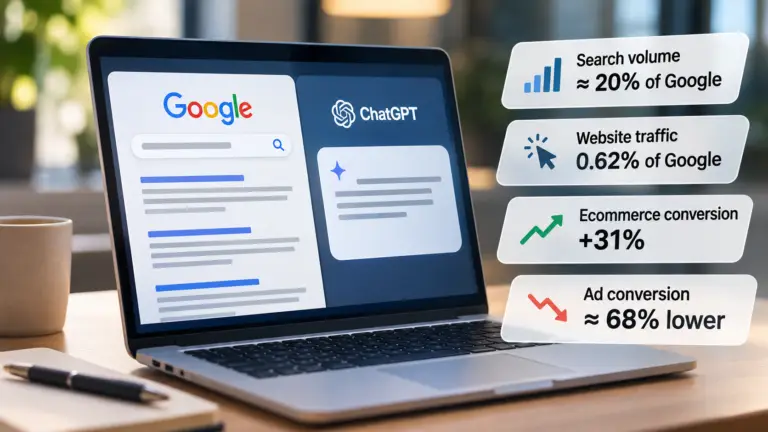
OpenAI reported that ChatGPT processes roughly 20% as many search-like queries as Google. That’s a substantial figure and demonstrates how quickly AI has become part of how people look for information.
However, the comparison comes from OpenAI, and the underlying figures and methodology have not been independently verified. More importantly, search volume does not necessarily translate into website traffic.
An
October 2026 study reported by Search Engine Land analyzed more than 145 million sessions across 100 websites. It found that ChatGPT generated traffic equal to just 0.62% of Google’s organic search traffic. Even when including referrals from other AI platforms, that number increased to only 0.73%.
Those numbers initially seem difficult to reconcile, but they’re measuring entirely different things.
People can ask ChatGPT questions and receive helpful answers without ever visiting a website. They may also discover a business through AI and later reach its website through Google, a direct visit, or another channel.
This means AI may be influencing customer decisions without necessarily receiving credit for the resulting website traffic. At the same time, the referral data demonstrates that traditional search continues to drive substantially more measurable website visits in the businesses studied.
Both findings matter when evaluating AI’s current role in search.
AI Search Conversion Rates Tell Another Interesting Story
Traffic volume is only part of the equation. The quality of that traffic and its ability to generate business are equally important.
A
February 2026 study of 94 ecommerce websites found that visitors coming from ChatGPT had a 31% higher conversion rate than visitors from non-branded Google organic search, suggesting that some consumers may be arriving at websites further along in their purchasing decisions.
However, another study paints a different picture when looking at paid traffic.
Research reported in November 2026 found that visitors coming from ChatGPT advertising converted at a rate approximately 68% lower than visitors from Google Search advertising. The study also found significantly lower revenue per visit from ChatGPT ads.
These findings highlight the importance of context. The studies examined different traffic types, websites, and customer behaviors, so they shouldn’t be interpreted as a direct comparison of organic and paid AI performance.
It’s also important to recognize that AI advertising is still developing. Early results may change as the platforms, advertisers, and consumer behaviors mature.
The broader takeaway is that AI search cannot be evaluated through adoption numbers alone. Traffic quality, conversion rates, and actual business outcomes remain essential measurements.
How Is the Marketing Industry Responding to AI Search?
As AI adoption grows, the marketing industry is developing new approaches to search visibility, commonly referred to as GEO and AEO.
These strategies generally focus on helping businesses appear in AI-generated answers, recommendations, and search experiences. However, they are not necessarily separate from traditional SEO.
In fact,
Google’s guidance on AI search features explains that established SEO best practices remain relevant to its AI Overviews and AI Mode, without requiring special technical optimizations.
While other AI platforms have their own methods for finding and evaluating information, the underlying objective is similar: provide people with helpful, relevant, and trustworthy answers.
That reinforces the value of strong website content, clear service information, accurate business details, and established credibility. These are principles that have long supported effective SEO and remain relevant as search technology evolves.
GEO and AEO introduce additional considerations, particularly around how AI systems discover, interpret, and reference information. But they should generally complement strong SEO practices rather than replace them.
What Should Businesses Take Away From the Current Data?
The research shows that AI is becoming an increasingly important part of how people search, but its measurable impact on website traffic and conversions is still developing.
That doesn’t mean businesses should ignore AI search or continue doing things exactly as they always have.
It means businesses should be actively monitoring how these changes affect their customers and marketing performance. That includes evaluating AI referral traffic, understanding how their business appears in AI-generated answers, and adjusting their content and optimization strategies as meaningful opportunities emerge.
It also means continuing to invest in marketing channels that are already delivering measurable results.
For many businesses, the strongest path forward is to build upon established SEO practices while expanding their understanding of how AI platforms are changing discovery and customer behavior.
AI Search Is Evolving, and So Should Marketing Strategies
The research available in late 2026 presents an interesting contrast. ChatGPT is handling a substantial number of search-like queries, yet traditional Google search continues to generate far more measurable website traffic. Meanwhile, early conversion studies show both promising opportunities and areas where AI-driven traffic has not yet matched established channels.
These findings will undoubtedly change as the technology and the ways people use it continue to evolve.
The important thing is not to choose sides between AI and traditional search. It’s to understand what the available evidence tells us, continue measuring meaningful business outcomes, and make informed adjustments as the landscape develops.
AI is changing search. The opportunity for businesses is to understand those changes and respond with strategy rather than speculation.